In recent years, the word "toxicity" has become almost commonplace. We often label as toxic anything that exhausts us, hurts us, or requires effort from our side.
However, it is important to distinguish between a "toxic" person and a person who is simply "difficult." It is this difference that determines whether we can be near them without losing ourselves.
This text is an attempt to differentiate these two concepts. Not for the sake of labeling, but to learn how to better hear ourselves and preserve our own psychological integrity.
A difficult person: it's not easy to be near them, but it isn't destructive
A difficult person may be emotionally unavailable, silent, or detached. They often have deep internal feelings, but they do not use someone else's pain as a tool.
They do not humiliate, devalue, or manipulate. Usually, they recognize their limitations and take responsibility for their states. And most importantly — they do not destroy the self-esteem of others.
Such a person may be overwhelmed by something of their own. Their internal world is sometimes closed off, narrowed, or frozen. It may be hard to rely on them. Being near them can be sad, painful, or lonely — but you do not lose yourself.
You may feel fatigue or disappointment, but not worthlessness or guilt for the very fact of your existence.
Separately, it is worth mentioning aggression. Otherwise, it would be easy to declare everyone who is alive, temperamental, or traumatized as "toxic."
The point is not the strength of the emotions, but what they do to the connection.
A difficult person can also get angry or lose control. But their aggression is rather the language of their state: "I feel very bad right now," "I am angry," "I am overwhelmed."
They may react sharply, but they do not attack your value as a person. They are capable of later realizing their state and taking responsibility for their reactions. Their aggression is not a way to control another person.
Their pain is their pain. And that can be felt.
A toxic person: it is psychologically dangerous to be near them
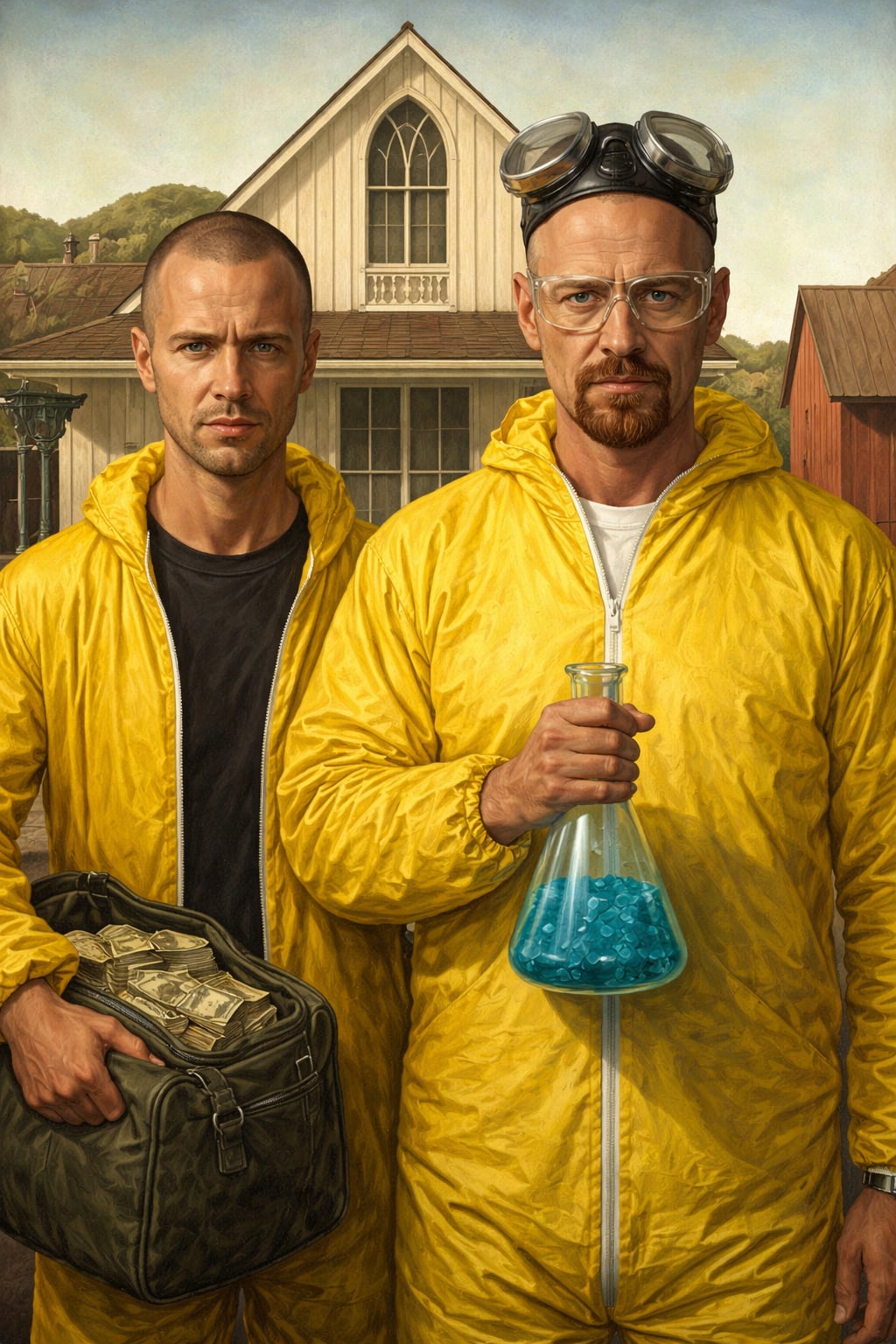
Grant Wood's painting American Gothic is often perceived as an image of stability and tradition. But there is almost no life in it.
Two people stand side by side — correctly, restrained, according to their roles. And yet, there is no warmth felt between them. Sometimes toxicity looks exactly like this: not as overt violence, but as a world where being alive is not allowed.
A toxic person is not necessarily a "monster." Often, they are also a wounded person. But the difference is that they discharge their own tension onto others and violate boundaries — and this inevitably affects the psyche of those nearby.
Most often, it manifests like this:
- a toxic person devalues, humiliates, or manipulates under stress
- distorts reality, making you doubt your own feelings
- shifts blame
- strikes at the most vulnerable spots
- may apologize, but the pattern repeats
- if they do take responsibility, it is only after the damage is done
Being near such a person often results in:
- constant tension
- heightened self-control
- fear of saying the "wrong thing"
- a feeling that you need to justify yourself
- uncertainty, as if walking on thin ice
After contact, self-esteem may suffer; there is a sense of depletion, a feeling as if you've been "run over." Their pain becomes your pain.

Why this is important in relationships
With a difficult person, the safety protocol is relatively simple: maintain boundaries, do not try to "save" them, and remain yourself.
With a toxic person, it is much more complicated. Boundaries are constantly violated, self-esteem gradually decreases, and doubt in one's own thoughts and feelings arises. Over time, you may feel as if you are disappearing as an individual.
Let's look at some examples.
Difficult but not toxic person (suffers themselves, does not destroy the other)
Jesse Pinkman ("Breaking Bad") — traumatized, addicted, unstable; lots of pain, guilt, and shame. He is not easy to be with, but he does not systematically destroy the other.
Severus Snape ("Harry Potter") — harsh, closed off, doesn't know how to be warm. But he does not destroy those he truly loves, and he does not impose his darkness onto others.
Shrek ("Shrek") — traumatized by rejection, rude, defensive. But capable of love and responsibility.
Toxic person (discharges tension at the expense of the other)
Walter White ("Breaking Bad") — shifts responsibility, manipulates "for the sake of the family," controls and destroys others while justifying it.
Mother Gothel ("Tangled") — love as control, devaluation, fear instead of support. Her love has a condition: Rapunzel must remain dependent and afraid of the world. Gothel doesn't just forbid, she devalues. She doesn't hold others by force, she convinces that survival is impossible without her. In this way, love gradually becomes a cage where there is no room for self-trust.
What about Ukrainian literature?
Difficult, but not toxic
Lukash ("The Forest Song" by Lesya Ukrainka) — immature, confused, cannot handle intimacy, but does not destroy Mavka intentionally.
Mavka — different, vulnerable, loves deeply, but does not destroy.
Ivan ("Shadows of Forgotten Ancestors" by M. Kotsiubynsky) — stuck in loss, but does not humiliate others.
Zhadan’s lyrical hero — broken by history and war, but honest and not manipulative.
Toxic characters:
Kaydashykha ("The Kaidash Family" by Nechuy-Levytsky) — control, devaluation, humiliation under the guise of morality, destruction of boundaries.
Marusia Kaidash — reproduction of an aggressive model, secondary toxicity.
Lukash’s mother ("The Forest Song") — control through "care," devaluation of otherness.
Also, a lot of toxicity has been normalized in Soviet narratives about "proper" people: emotions = weakness, individuality = threat.
Modern context
There are veterans with PTSD who recognize their difficulties, take responsibility, and try to protect their loved ones, including from their own internal experiences. They may be difficult — but they are not toxic.
And there are those who:
- justify their own aggression with the war
- justify violence with trauma
- demand patience "because it's hard for me"
- say: "I didn't send you there" or "How could you let him go there?!"
If we reduce the above to a simple formula:
A difficult person is someone whose suffering needs space. A toxic person is someone whose suffering takes away your space.
Your task is to feel this difference. Because love should not require self-destruction. And intimacy should not cost you your integrity.